National Cattle Trails Conference — Oct. 23-24, 2026

Join us in Sedalia, Missouri to celebrate the rich history of these historic cattle trails: Shawnee, Goodnight-Loving, Chisholm, Great Western, and Western.
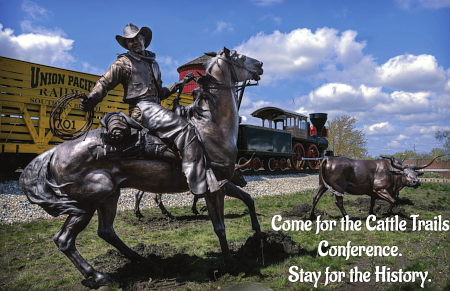
On Friday, the conference includes a keynote address on "Jack Thorp and the First Book of Cowboy Songs," a discussion of vaqueros and the Spanish cattle history, legislative updates, Western art history, and an artist reception. On Saturday, the conference continues with sessions on the many types people who worked as drovers, "Wyatt Earp and the Cowboys: Law Enforcement in the Cow Towns of Wichita and Dodge City," "Train History, Cattle Drives, and Western Expansion," and "Engaging Younger Generations with Western Heritage," among others.

Come a day early (Thursday, Oct. 22) for a guided tour that includes the Trails End Monument on the Missouri State Fairgrounds, the Sedalia Historic District, Marshall Junction, and a longhorn ranch. That night, enjoy music from 3 Trails West and the Diamond W Wranglers, and cowboy poetry from Jeff Davidson and Ron Wilson.

These six trail organizations are participating: the Shawnee Cattle Trail; Goodnight-Loving Trail, Inc.; the International Chisholm Trail Association; the Texas Chisholm Trail Association; the Great Western Cattle Trail Association; and the Western Cattle Trail Association.

Sedalia, Missouri: The Original Cow Town

Founded in 1860 just as the railroad reached it from the east, Sedalia was an important rail depot. When the Civil War ended, commerce intensified. There was a huge pent-up demand, a hunger for beef back east, and a vast supply of maverick longhorn cattle roaming the open ranges of Texas. To get them to market, the cattle drive was born in 1866.

Some of the first cattle drives headed north along the eastern edge of the Indian Territories along what was known as the Sedalia Trail. Sedalia was the goal and destination to which the drovers pushed their herds. Once they reached Sedalia, the longhorns could be loaded on cattle cars and shipped by rail to the stockyards of St. Louis, Chicago, and points further east.

Even after its role as the end of the line had long passed, Sedalia was still connected to the shipment of cattle to the east. The extension of the Katy Railroad from Sedalia to Texas resulted in Sedalia becoming a major watering and rest stop for the endless stream of live beef headed east to the packing houses.

Formation

The Historic Cattle Trails Consortium was formed in Dodge City, Kansas on November 1, 2024, with a joint letter in support of a Cattle Trails Consortium signed by representatives from the Chisholm Trail, the Great Western Trail, the Goodnight-Loving Trail, the Shawnee Trail, and the Western Trail.

They said, "We the undersigned believe the pre- and post-Civil War cattle trails were and are a vital and valuable part of American history. On these trails in the late 1800s, millions of longhorn cattle were moved by drovers on horseback hundreds of miles from south Texas to markets in the east, north, and west. Not only did this trade have a significant impact on the nation's economy, it served multiple purposes such as meeting consumer demand for beef, stocking ranches in northern ranges, and providing crucial supplies for Native American tribes. Furthermore, the exploits of the daring young riders along the trails gave rise to the American cowboy, an enduring and globally recognized icon of our nation's strength, courage, independence, and bravery."

See the full letter here.

  • Goodnight-Loving Trail, Inc.
  • Great Western Cattle Trail Association
  • International Chisholm Trail Association
  • Shawnee Cattle Trail
  • Texas Chisholm Trail Association
  • Western Cattle Trail Association